

THE VELÁZQUEZ LAB · UC DAVIS CHEMISTRY
Solid-State Materials Chemistry for Energy Conversion, Energy Storage, and Environmental Science
ABOUT THE LAB
In the Velázquez Research Group at UC Davis, we develop advanced materials to address challenges in clean energy, environmental remediation, and nanoelectronics. We design materials with precisely controlled structures—including atomically thin layers, nanocrystalline films, and porous solids—and investigate how their structures influence their properties and performance. By combining materials synthesis with microscopy, spectroscopy, electrochemistry, and synchrotron-based techniques, we connect fundamental chemistry with practical applications.
15
current lab members and visiting scientists
22
alumni now in academia, national labs and industry
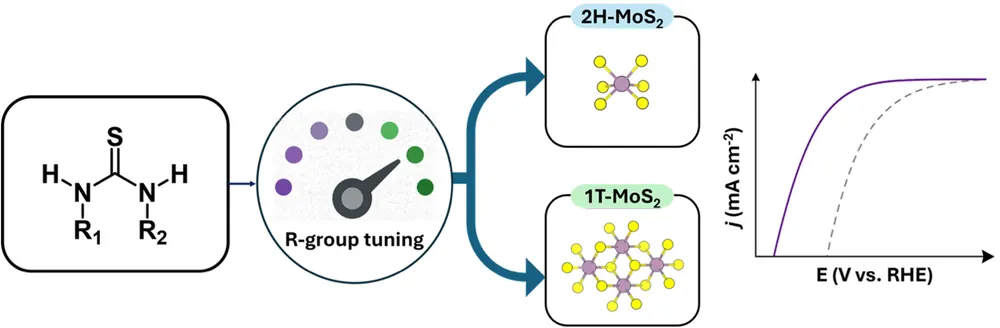
LATEST PUBLICATION
Modulation of organosulfur sources hydrothermally captures MoS2 polytypes with tailored electrochemical activity
Kalita, D.; Ninawe, P.; Robinson, K.P.; Krastev, A.; Cordones, J.; Velazquez, J.M.; De Jesus Baez, L.R.
Journal of Materials Chemistry A, 2026
Our research
Three connected programs, from making new materials to understanding how they work in devices and in the environment.
01
Synthesis of Multidimensional Materials
We leverage microwave-assisted solid-state synthesis, flash Joule heating, metal organic chemical vapor deposition (MOCVD), and complementary processing techniques to synthesize multinary chalcogenides, heterostructures, and nanostructured thin films, tailoring their composition and microstructure to achieve application-specific properties and functionality.
02
Spectroscopic Evaluation
We employ ex situ and operando measurements at synchrotron facilities worldwide (SLAC, SLS, etc.) to probe electronic structure and local coordination environments using soft, tender, and hard X-ray absorption spectroscopy (XAS), complemented by scanning transmission X-ray microscopy (STXM) and resonant inelastic X-ray scattering (RIXS).
03
Electrochemistry
We investigate fundamental electrochemical processes governing interfacial charge transfer, reaction kinetics, and ion transport to guide the design of electrocatalysts for CO₂ reduction, the hydrogen evolution reaction (HER), and nitrate reduction, as well as electrode materials for aqueous batteries. Our work connects electrode-electrolyte interactions and reaction mechanisms with catalytic activity, selectivity, and stability, alongside charge-storage performance and cycling reversibility.
Recent publications
- In Situ spectroscopic evaluation of copper corrosion during electroreduction of CO2-amine adducts
ACS Applied Energy Materials, 2026 - Potassium Molybdenum Chalcogenides: Electronic Structure Modulation through Cluster Dimensionality
Chemistry of Materials, 2026 - Flash-Joule heating enables rapid solid-state synthesis of multinary chalcogenides: a case study on Cu2Mo6S8
Chemical Communications, 2026
In the news
- What to watch for in chemistry in 2025
C&EN - Carbon capture method mines cement ingredients from the air
UC Davis Letters & Science - Building a space for academic rigor and empathy: tracing the origin of a chemist with Jesús Velázquez
UC Davis Letters & Science
Watch
C&EN Talented 12: an interview with Professor Jesús Velázquez
2025 UC Davis commencement: Professor Velázquez addresses the graduating class (watch from 35:28)
Join the lab
We welcome prospective graduate students, undergraduates and visiting scholars who want to build materials for energy and the environment. Through INSPIRA and our outreach programs, we also open research pathways for students from community colleges, Hispanic-Serving Institutions and HBCUs.